The Summer That Changed College Sports
The summer of 2025 marked a historic turning point in college athletics. In June of 2025, the House v. NCAA lawsuit reached a final settlement, allowing U.S. universities— for the first time ever— to directly share athletic revenue with their student-athletes.
The case was led by Grant House, a former Arizona State swimmer, along with other athletes who challenged the NCAA’s long-standing restrictions on compensation. Their argument was straightforward: rules limiting earnings from Name, Image, and Likeness (NIL) and prohibiting direct pay were anticompetitive.
The result? A complete shift in the financial model of college sports.
From Amateurism to Direct Pay
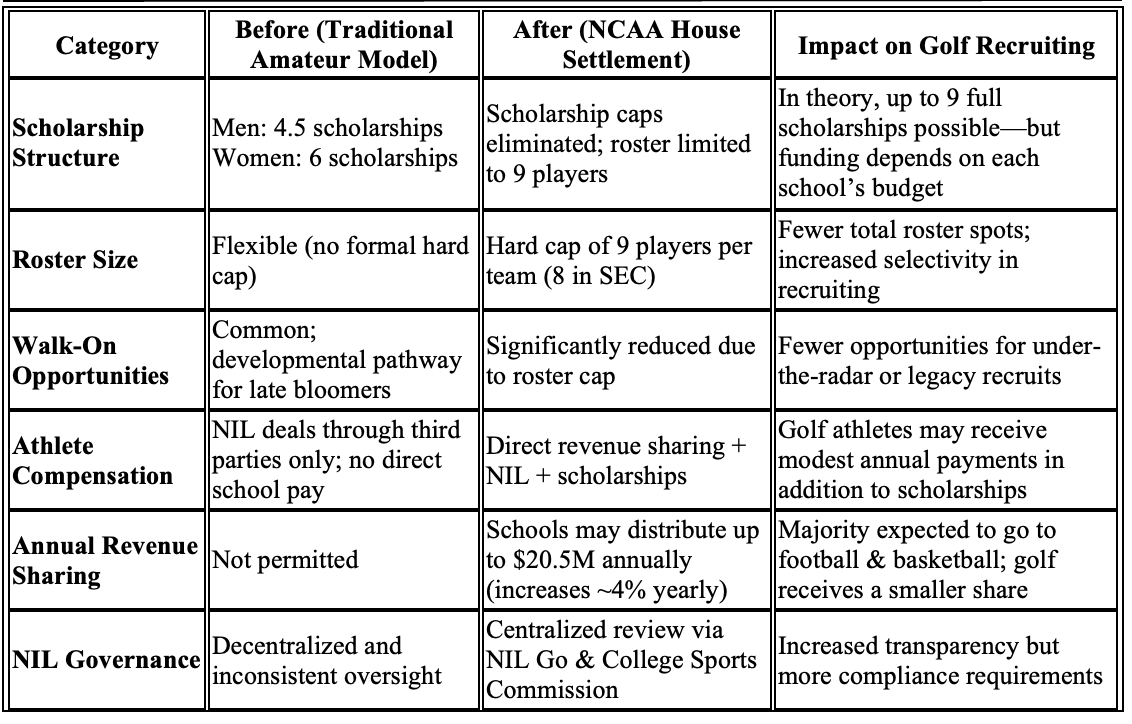
Beginning in the 2025–26 academic year, Division I schools that opted into the settlement may now share up to $20.5 million annually with their athletes. That figure represents roughly 22% of average athletic department revenue and will increase by approximately 4% each year.
Historically, the “Power 5” referred to the ACC, Big Ten, Big 12, Pac-12, and SEC—the most financially dominant conferences in Division I. Following conference realignment, the Pac-12 has dissolved, leaving what many now call the “Power 4.” These schools drive most of the revenue in college athletics with their football and basketball programs.
On the surface, revenue sharing formalizes an earning pathway that makes college sports look far more like professional leagues. For many athletes, that’s a major win.
But for Olympic sports like golf—programs that already operate on leaner budgets—the picture is more complicated.
Golf in a Football and Basketball Economy
While all athletes at opt-in schools are eligible for revenue sharing, football and men’s basketball are expected to receive the overwhelming majority—potentially more than 90% of distributed funds. These are the sports that generate revenue, and athletic departments will budget accordingly.
College golf, by contrast, is a non-revenue sport at nearly every NCAA institution. Programs rely heavily on university funding, alumni donations, and private sponsorships. Even elite programs such as Oklahoma State, Arizona State, and Florida rarely operate at a financial surplus.
With schools now responsible for up to $20.5 million in revenue-sharing obligations, athletic departments will need to rebalance budgets.
For golf, that could mean:
· Uncertain scholarship funding – Well-funded programs may increase scholarships, while others reduce them, widening the gap in competitive balance.
· Smaller rosters and heightened competition – Coaches will be forced to be more selective.
· The decline of the walk-on pathway – Fewer opportunities for late bloomers and under-the-radar players.
· Modest revenue-share payments – Likely small compared to football and basketball distributions.
· Increased compliance complexity – NIL Go oversight and additional administrative layers.
· Reduced travel budgets – Fewer national events and more regional competition. less trips for winter practice or to Hawaii or Puerto Rico for competitions and more teams traveling regionally.
· Fewer individual tournament opportunities – Limited depth participation.
· In extreme cases, potential program cuts.
So What Has Actually Changed in College Golf?
1. Roster Limits Replace Scholarship Caps
Previous scholarship caps (4.5 for men, 6 for women) have been eliminated. Instead, teams are limited to nine rostered players (eight in the SEC). In theory, all nine could receive full scholarships—though actual funding will vary by institution.
This is a dramatic structural shift. For the first time, schools may fully fund up to 9 scholarship players. Whether they choose to is another discussion (the Top30 programs will likely see their funding increase).
2. Walk-Ons Face a New Reality
With roster caps in place, traditional walk-on opportunities are shrinking. Programs that once allowed developmental players or legacy recruits to grow into contributors in the starting lineup may no longer have that flexibility. This represents a significant cultural shift in college golf.
3. Revenue Sharing Arrives (Modestly)
Although golf will not command a large portion of revenue pools, players may receive modest payments—often a few thousand dollars annually, depending on institutional revenue. These payments are in addition to scholarships and traditional NIL opportunities.
4. NIL Oversight Expands
All NIL agreements exceeding $600 must now pass through the NIL Go clearinghouse for fair-market validation. While this increases transparency, it also introduces additional administrative steps for athletes and schools.
What This Means for Aspiring College Golfers
For junior golfers pursuing NCAA opportunities, the recruiting landscape has shifted.
The upside:
· Direct revenue sharing is now possible.
· NIL opportunities remain viable.
· Scholarship flexibility technically increases.
The challenge:
· Golf will only receive a small percentage of the overall revenue pool.
· Roster caps mean fewer total spots.
· Coaches are taking fewer developmental “flyers.”
Future recruits should:
· Prioritize schools with a demonstrated commitment to golf.
· Ask how revenue sharing will be distributed within the athletic department.
By sport revenues? per-athlete flat rate? academic incentives?
· Explore golf-specific NIL partnerships and local sponsorships.
· Consider Division II, NAIA, or international pathways where funding distribution may be more balanced.
What are Coaches Saying
“The roster cap has certainly made recruiting more selective. It is only a few less players than many programs were carrying previously, but those 2 or 3 less spots make a difference. You really need to bring in freshmen now who have a good possibility of making an impact early for your program. It is harder to take a flyer on a more developed player who might not be able to help for a few years.” - Matt Davidson, Head Coach, Furman University
“The new Division I model makes recruiting more selective. That creates opportunity at the Division II level. Programs committed to investing in golf can attract high-level players who want a real role, real development, and a chance to compete for championships. This is a moment for Division II to keep closing the gap.” -Bryson Worley, Head Coach, University of North Georgia (D2)
Coaches will have to make tough decisions on how they spend their athletic budget dollars. We will have to decide if we spend it on a trackman, a winter trip, or do we double down on 2-3 guys with revenue share money and then take a few walk-ons” – Trake Carpenter, Head Coach, Nevada Men’s Golf
“I just see a loss of opportunity in Division I for someone who might be just 6 months or a year away from having their competitive breakout. Prospects need to keep an open mind to all schools/divisions if golf is one of their goals for college. I believe you should still pick a school you would attend if golf was not part of the equation. Your degree is going to pay many more dividends than any NIL or rev share. School pride and being a part of building a program seems like it’s going to be a rarity. If a player has success in Division III or a mid-major, there is this temptation to want to jump to the P4. I would love to see players and coaches remain loyal to each other for the 4-year experience. There’s a lot to be said for creating a bond with your teammates, believing in your process, and watching your team evolve over time. It’s hard to build a roster if you are uncertain about who might be leaving your team early for the portal.” – Adam Decker, Head Coach, Richmond Men’s Golf
The Bottom Line
The House v. NCAA settlement represents a historic shift in college athletics. It empowers athletes and modernizes compensation structures—but it also intensifies financial pressure on non-revenue sports.
For college golf programs, survival won’t be automatic. Investment decisions will vary by institution. The programs that thrive will be those whose universities view golf as a core sport—not an expendable one.
In recruiting, the impact is already clear: smaller rosters, increased selectivity, and fewer developmental opportunities. The margin for error is shrinking. Coaches will be more selective with who they decide to recruit and are taking fewer “fliers” on legacy recruits and “high ceiling” players.
For athletes and families, a proper recruiting strategy matters more than ever.
And for coaches, every roster decision carries more weight.
In this new era, fit and long-term program investment matter more than logo & notoriety.
Thanks for reading,
Michael J. Smith
Founder, ForeCollegeGolf
ForeCollegeGolf is a college placement and recruiting business where Mike aims to apply his background in competitive golf and recruiting education to help educate players, their families, and coaches about the college recruiting process.
If you have any questions about the article above, any feedback, an article idea you would like to provide; you can contact us at mike.smith@forecollegegolf.com or www.ForeCollegeGolf.com
Copyright @ – 2026 – ForeCollegeGolf or Golf Excellence LLC